Best Helmet Enchantments Minecraft Guide: The Maxed Survival Build

The best helmet enchantments Minecraft players should use are Protection IV, Respiration III, Aqua Affinity I, Unbreaking III, and Mending I. Add Thorns III only if you value automatic damage more than durability efficiency. This six-enchantment setup is the maxed general-purpose helmet for survival, building, ocean exploration, and most combat.
A helmet deserves its own plan because Respiration and Aqua Affinity do jobs no other armor slot can replace. The best combination is not simply “every book that fits,” though: protection types conflict, Thorns has a real tradeoff, curses are usually unwanted, and careless anvil use can make the last book too expensive. This guide separates essentials from optional upgrades and shows how to plan the books before using the Minecraft enchantment calculator.
Table of Contents
Best Helmet Enchantments Minecraft Quick Answer
For one helmet that you can wear almost everywhere, build Protection IV + Respiration III + Aqua Affinity I + Unbreaking III + Mending I. Protection covers common damage, the two helmet-only upgrades transform underwater work, and the durability pair keeps a good diamond or netherite helmet in service. Thorns III is the optional sixth enchantment rather than an automatic requirement.
| Priority | Enchantment | Maximum level | Verdict |
|---|---|---|---|
| 1 | Protection | IV | Best broad defense for a general helmet |
| 2 | Respiration | III | Essential for underwater exploration and building |
| 3 | Aqua Affinity | I | Essential when mining or building underwater |
| 4 | Unbreaking | III | Essential durability support |
| 5 | Mending | I | Best long-term repair option |
| Optional | Thorns | III | Useful for some combat builds; costs extra durability |
| Alternative | Fire, Blast, or Projectile Protection | IV | Replace Protection for one specialized threat |
| Avoid | Curse of Binding / Vanishing | I | Usually a drawback in survival |

Helmet-specific rule: Respiration III and Aqua Affinity I are compatible with each other and with the durability enchantments. The real build fork is your protection type, because Protection, Fire Protection, Blast Protection, and Projectile Protection do not normally stack on the same helmet.
Helmet Enchantment Ranking
Protection IV: The Best Default Defense
Protection IV is the safest first choice for a helmet worn during ordinary survival. A typical session mixes melee hits, arrows, explosions, falls, fire, and environmental damage, so broad protection is more convenient than optimizing for one narrow danger. It also keeps the helmet aligned with a standard four-piece armor set instead of forcing constant gear swaps.
Specialized protection is not bad; it is situational. Fire Protection can make sense for repeated Nether work, Blast Protection for explosion-heavy challenges, and Projectile Protection for ranged combat. Those books replace Protection IV on that helmet. They are not extra layers to add afterward.
Respiration III: More Useful Time Underwater
Respiration extends the time you can work before air becomes the limiting factor. That matters in ocean monuments, shipwrecks, flooded caves, underwater farms, drainage projects, and decorative builds. Even when you carry doors, potions, conduits, or other breathing solutions, Respiration gives you more margin when a route or building step takes longer than expected.
Choose the maximum level, Respiration III, for a helmet you plan to keep. Lower levels can help an early iron helmet, but upgrading that book through repeated anvil work may add avoidable prior-work history. A max-level book is cleaner when you are building a permanent diamond or netherite setup.
Aqua Affinity I: The Underwater Mining Upgrade
Aqua Affinity addresses a different problem: underwater mining speed. It makes breaking blocks underwater feel far closer to normal mining, which is valuable for monuments, glass domes, foundations, farms, tunnels, and cleanup after waterlogged construction. It has only one level, so Aqua Affinity I is already complete.
The enchantment does not turn every underwater penalty into an instant-mine effect. Tool quality, Efficiency, Mining Fatigue, and whether the player is properly positioned can still matter. Its value is that it removes the helmet-related underwater mining handicap, not that it overrides every other game mechanic.
Unbreaking III and Mending I: The Durability Core
Unbreaking III reduces how quickly the helmet consumes durability, while Mending I uses collected experience to repair equipped or held gear that needs repair. Together they protect the time spent finding materials, books, and levels. This pair is especially useful if Thorns is present, because Thorns can cause extra durability use when it triggers.
Do not wait until a valuable helmet is nearly broken before thinking about repair. Keep an eye on durability, remove other damaged Mending items when directing XP to the helmet, and repair before a long expedition. Mending makes gear renewable in practice only when you actually collect XP and prevent the item from breaking first.
Thorns III: Optional, Not Automatically “Best”
Thorns can damage attackers when they hit you, which is appealing in PvP or dense mob combat. The tradeoff is additional durability pressure and less control over what receives damage. It can also be unnecessary when your weapon already ends ordinary fights quickly. That makes Thorns III a build choice, not a mandatory box to tick.
Skip Thorns on a first good helmet if repair access is limited. Add it to a late-game netherite set when you have Mending, reliable XP, and a reason to value retaliation damage. If you want Thorns across a full armor set, plan the entire set rather than judging the helmet in isolation; the best armor enchantments guide covers that broader decision.
Respiration vs Aqua Affinity on a Helmet

Respiration and Aqua Affinity are complements, not competitors. One keeps air from becoming urgent so quickly; the other keeps block breaking from becoming painfully slow. If the project involves any sustained underwater work, use both on the same helmet.
| Question | Respiration III | Aqua Affinity I |
|---|---|---|
| Primary job | Extends useful underwater breathing time | Improves underwater mining speed |
| Helps exploration? | Yes, especially routes between air sources | Only when blocks must be broken |
| Helps building? | Gives more time per underwater task | Makes placement cleanup and excavation faster |
| Can they combine? | Yes. Put both on the same finished helmet. | |
Protection IV vs Specialized Helmet Protection
A maxed helmet does not contain all four protection categories. In normal survival, Protection conflicts with Fire Protection, Blast Protection, and Projectile Protection. The correct question is therefore which defensive profile the helmet should serve.
| Protection choice | Best use | Recommendation |
|---|---|---|
| Protection IV | Mixed survival, caves, travel, bosses, everyday combat | Best default for one main helmet |
| Fire Protection IV | Repeated fire and lava exposure, Nether-focused tasks | Specialized backup helmet |
| Blast Protection IV | Creepers, TNT, crystals, explosion-heavy challenges | Specialized backup helmet |
| Projectile Protection IV | Arrow-heavy fights and ranged threats | Specialized backup helmet |
Best Minecraft Helmet Builds by Use Case
Best All-Purpose Survival Helmet
Protection IV, Respiration III, Aqua Affinity I, Unbreaking III, Mending I
This is the best first permanent helmet. It covers mixed damage, water exploration, underwater construction, and long-term durability without paying the extra Thorns durability cost.
Maxed Late-Game Helmet
Protection IV, Respiration III, Aqua Affinity I, Unbreaking III, Mending I, Thorns III
Use this when Mending and XP access are already reliable. It maximizes the useful compatible enchantment set for a general helmet, but “maxed” does not mean all protection types can be added together.
Best Underwater Work Helmet
Respiration III, Aqua Affinity I, Unbreaking III, Mending I, Protection IV
The list looks like the general build because the underwater pair fits without sacrificing broad defense. Combine it with the right tools and breathing support for large ocean monuments, conduits, glass domes, farms, or drainage work.
Best Early-Game Helmet
Protection III or IV, Unbreaking II or III, then Respiration if available
Improve a temporary iron or diamond helmet with the books you can replace. Save rare Mending and ideal max-level books for the item you intend to keep, especially when early anvil costs would create prior work on a disposable piece.
Best Specialized Threat Helmet
Fire, Blast, or Projectile Protection IV + Respiration III + Aqua Affinity I + Unbreaking III + Mending I
Build this only for a repeatable threat that justifies swapping away from general Protection. Label backup helmets clearly so the wrong piece does not end up in a mixed expedition.
Already have the helmet books? Calculate the lowest-cost combination order before the first anvil use.
Calculate Helmet Anvil OrderBest Anvil Order for Helmet Enchantments
The safest rule is to build a balanced combination tree instead of placing six books directly onto the helmet one after another. Every anvil operation increases prior work on the resulting item. Repeatedly touching the helmet can make later operations expensive even though all of the enchantments are technically compatible.
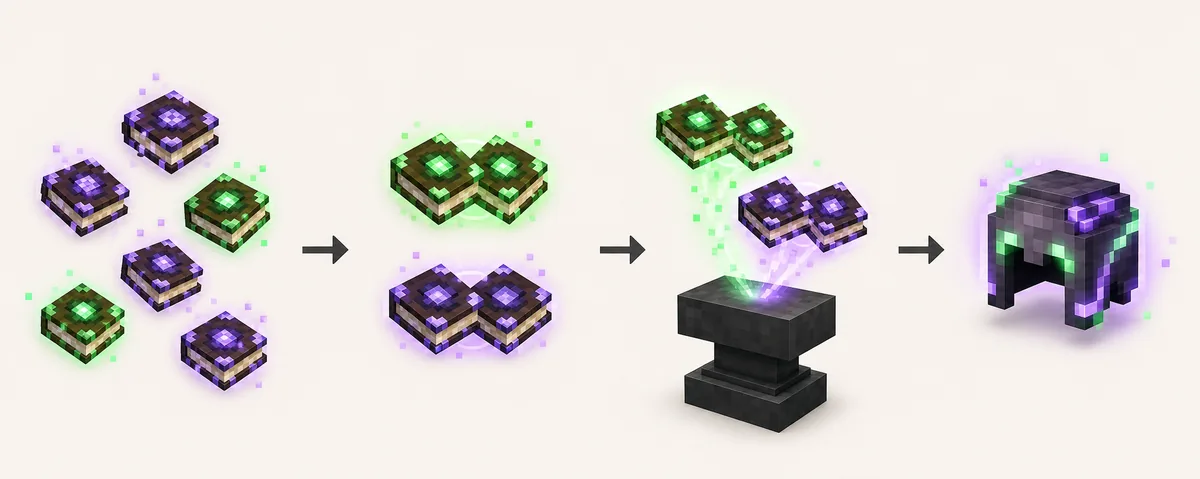
- Choose Protection IV or one specialized protection before buying and combining the rest.
- Decide whether Thorns III belongs in this build; skipping it reduces both book count and future durability pressure.
- Prefer fresh max-level books when possible. Books made by repeatedly merging lower levels may already carry prior work.
- Pair compatible books into balanced groups rather than adding each book directly to the helmet.
- Enter the actual item and enchantments in the calculator before committing to the left-slot and right-slot order.
A single hard-coded sequence cannot be cheapest for every inventory. Enchantment rarity affects anvil cost, and two books with identical visible enchantments can have different work histories. A villager book, a loot book, and a book created through several merges are not necessarily equivalent inputs. If a preview looks wrong, check the Minecraft anvil cost guide and the detailed prior work penalty explanation before spending levels.
Java and Bedrock Helmet Notes
The central recommendation is the same in Java and Bedrock: use one protection type, add Respiration and Aqua Affinity, then support the helmet with Unbreaking and Mending. Thorns remains optional. The useful maximum levels in the table above are also the practical targets for a vanilla survival build.
Where players can obtain particular books, how servers handle trading, and which custom enchantments exist can differ by edition, version, experiment, plugin, or modpack. Treat this page as a vanilla build plan. On a custom server, check the in-game tooltip and local rules before applying expensive books. The site calculator is designed around normal enchantment compatibility and anvil logic, not every server-specific override.
Helmet Enchantments FAQ
What are all the best enchantments for a helmet in Minecraft?
The best general-purpose list is Protection IV, Respiration III, Aqua Affinity I, Unbreaking III, and Mending I. Add Thorns III only when its retaliation damage is worth the extra durability use. Curse of Binding and Curse of Vanishing are normally unwanted.
What is the maximum useful helmet enchantment setup?
A maxed general survival helmet has six useful enchantments when Thorns is included: Protection IV, Respiration III, Aqua Affinity I, Unbreaking III, Mending I, and Thorns III. Specialized protection replaces Protection rather than stacking with it, so the helmet does not legitimately hold every protection book in normal survival.
Does a helmet or boots have better enchantments in Minecraft?
They solve different problems. Helmets specialize in underwater breathing and mining through Respiration and Aqua Affinity. Boots have more movement and safety branches, including Feather Falling, Depth Strider, Frost Walker, and Soul Speed. The best full set needs both slots; compare them in the armor enchantment guide.
Can Respiration and Aqua Affinity go on the same helmet?
Yes. They are compatible and should normally be used together. Respiration supports breathing time, while Aqua Affinity improves underwater block breaking. Neither one replaces the other.
Should I put Thorns on my helmet?
Use Thorns III when you want retaliation damage and can maintain the helmet with Mending and reliable XP. Skip it on a first permanent set if durability efficiency and predictable repairs matter more.
Can I put Protection and Fire Protection on the same helmet?
Not in normal vanilla survival. Protection, Fire Protection, Blast Protection, and Projectile Protection are mutually exclusive choices on one helmet. Select one based on whether the helmet is general-purpose or a specialized backup.
What order should I put enchantments on a Minecraft helmet?
Start with fresh max-level books, combine compatible books into balanced groups, and avoid six direct helmet applications. Use the calculator for the exact order because enchantment costs and existing prior work change the cheapest sequence.
Do diamond and netherite helmets use different enchantments?
The recommended enchantment set is the same. Netherite has stronger material properties, but the enchantment roles do not change. If you plan to upgrade diamond gear, organize the enchantments and anvil cost before investing in the final item.
Sources and Further Reading
- All Enchantments in Minecraft - Minecraft Help Center for official enchantment names and broad effects.
- Helmet - Minecraft Wiki for compatible enchantments and helmet mechanics.
- Respiration - Minecraft Wiki for underwater breathing behavior.
- Aqua Affinity - Minecraft Wiki for underwater mining behavior.
- Minecraft Enchantment Guide for compatibility and maximum levels across gear.