Best Armor Enchantments in Minecraft: Helmet, Chestplate, Leggings and Boots
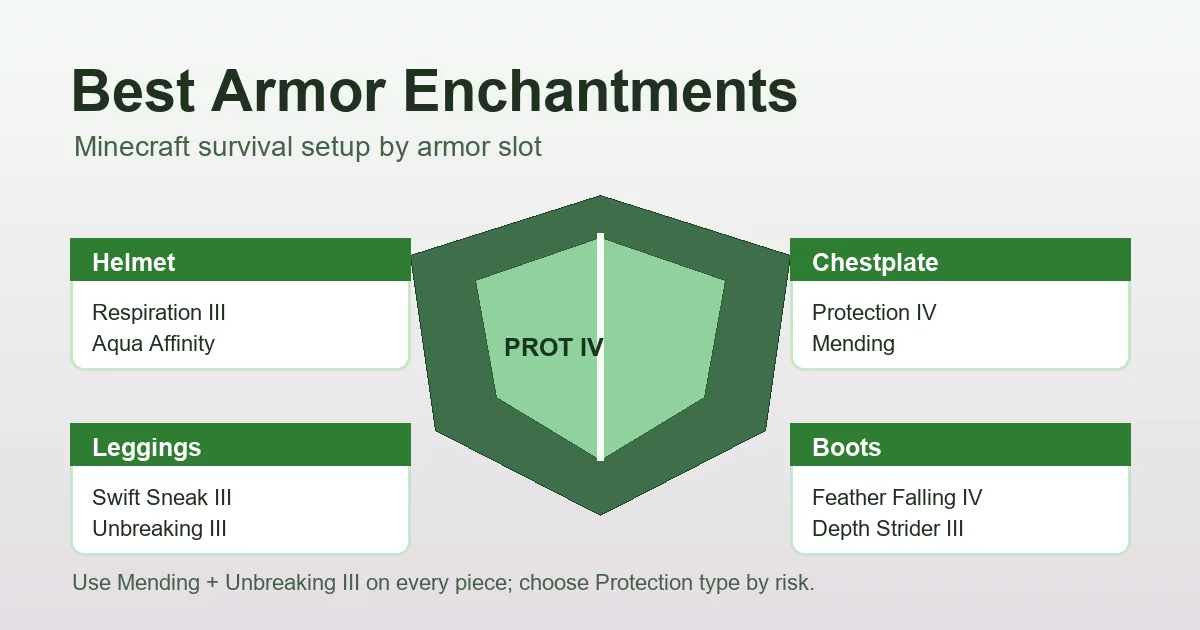
The best armor enchantments in Minecraft depend on the armor slot, but the core survival answer is simple: use Protection IV, Unbreaking III, and Mending on every piece, then add the slot-specific enchantments that actually change how you play. Your helmet wants Respiration III and Aqua Affinity. Your boots usually want Feather Falling IV and Depth Strider III. Your leggings may want Swift Sneak III. Your chestplate mostly needs the universal defensive set, with Thorns III only when the durability tradeoff is worth it.
This guide is intentionally narrower than our full best Minecraft enchantments build guide. Instead of covering swords, pickaxes, bows, and every playstyle at once, it focuses on one question: what should you put on a full armor set if you want a practical survival, Nether, exploration, or PvP setup without wasting anvil uses?
Table of Contents
Quick Answer: Best Full Armor Set
For most survival worlds, the safest all-purpose armor setup is:
| Armor piece | Best default enchantments | Optional or situational |
|---|---|---|
| Helmet | Protection IV, Unbreaking III, Mending, Respiration III, Aqua Affinity | Thorns III if you accept durability loss |
| Chestplate | Protection IV, Unbreaking III, Mending | Thorns III for PvP or mob-heavy farms |
| Leggings | Protection IV, Unbreaking III, Mending | Swift Sneak III for Ancient Cities and Warden areas |
| Boots | Protection IV, Unbreaking III, Mending, Feather Falling IV, Depth Strider III | Soul Speed III for Nether travel; Frost Walker II instead of Depth Strider for ice-path builds |
One-set recommendation: If you only want one armor set, choose Protection IV on every piece, Depth Strider III over Frost Walker II, and skip Thorns III until you have Mending and a reliable XP source.
Best Armor Enchantments by Slot
Helmet: Respiration III, Aqua Affinity, Protection IV, Unbreaking III, Mending
The helmet has the most obvious utility upgrades. Respiration III gives you much more time underwater, and Aqua Affinity removes the slow underwater mining penalty. These are not just ocean monument perks; they help with shipwrecks, flooded caves, river builds, and any base project that touches water.
Add Protection IV, Unbreaking III, and Mending as the survival baseline. Thorns III is optional. It can punish attackers, but it also consumes durability faster, so it is better on late-game netherite armor than on a fragile early diamond set.
Chestplate: Protection IV, Unbreaking III, Mending, Optional Thorns III
The chestplate does not have a unique survival enchantment in vanilla Minecraft, so it should carry the strongest universal defense package. Protection IV is the default because it helps against many common damage sources. Unbreaking III and Mending keep the item from becoming a recurring repair problem.
Add Thorns III if you play PvP, fight dense mob groups, or already have a stable XP farm. Skip it if you are still building your first good armor set, because the extra durability drain can become annoying before Mending is online.
Leggings: Protection IV, Unbreaking III, Mending, Swift Sneak III
Leggings are simple until you start raiding Ancient Cities. Swift Sneak III belongs on leggings and makes crouch movement much faster, which is valuable around sculk sensors, Wardens, and risky loot runs. Outside Deep Dark content, it is useful but not mandatory.
If you do not have Swift Sneak yet, do not delay the rest of your armor. Build the standard Protection IV, Unbreaking III, and Mending leggings first, then add Swift Sneak later if the anvil cost is still safe.
Boots: Feather Falling IV, Depth Strider III, Protection IV, Unbreaking III, Mending
Boots are the slot where players make the most tradeoff decisions. Feather Falling IV is almost always worth it because fall damage is one of the easiest ways to lose a survival world. Depth Strider III is the best general water movement choice and is usually better than Frost Walker II for normal exploration.
Soul Speed III is strong for Nether highways and soul sand valleys, but it also uses durability. If you travel in the Nether constantly, add it to your main boots after Mending. If you only use soul sand paths occasionally, consider a separate travel boot pair.
Protection IV vs Fire, Blast, and Projectile Protection
Protection enchantments are mutually exclusive on each armor piece in normal survival play. You cannot put Protection IV and Fire Protection IV on the same chestplate without commands. That means you are choosing a defensive profile, not stacking every possible shield.
| Protection type | Best use case | When to choose it |
|---|---|---|
| Protection IV | General survival, caves, raids, End fights, mixed threats | Choose this for your main everyday armor set. |
| Fire Protection IV | Lava, blazes, Nether exploration | Useful on a specialized Nether set, especially before fire resistance potions are easy. |
| Blast Protection IV | Creepers, TNT, crystals, explosive PvP | Good for PvP or technical work with explosives. |
| Projectile Protection IV | Skeletons, pillagers, arrows, tridents | Useful for specific farms or ranged-heavy encounters, rarely the best default. |
The practical rule is: use Protection IV unless you know exactly what is killing you. Specialized protection can outperform it against one threat type, but it gives up broad coverage. For a player who mines, explores, raids, builds, and fights bosses in the same world, broad coverage usually wins.
Java and Bedrock Notes
The recommended enchantment list is mostly the same in Java Edition and Bedrock Edition, but the surrounding mechanics can feel different. Java players usually pay more attention to anvil order because Java anvil costs are less forgiving when adding several expensive books. Bedrock players still need to plan, but the cost model is often more lenient when upgrading enchantment levels.
There are also behavior differences around specific enchantments and combat situations. For example, PvP communities often value Thorns differently depending on server rules and repair access. Treat the table above as a survival baseline, then adjust for the server or world you actually play.
Best Anvil Order for Armor
Armor has several expensive combinations, especially boots with Feather Falling, Depth Strider, Soul Speed, Protection, Unbreaking, Mending, and sometimes Thorns. If you add one book at a time to the boots, the prior work penalty climbs quickly and can push later operations toward the "Too Expensive!" limit.
Use the same balanced-book method explained in our Minecraft anvil cost guide: combine books in pairs first, then apply those combined books to the armor piece in a planned order. For boots, a practical sequence is:
- Combine Feather Falling IV + Depth Strider III.
- Combine Protection IV + Unbreaking III.
- Combine Mending + Soul Speed III if you are using Soul Speed.
- Apply the highest-value or highest-cost combined books to fresh boots while the boots still have a low penalty.
- Use the Minecraft enchantment calculator for any seven-enchantment boot set or any armor piece that already has prior anvil work.
Do not repair a good armor piece repeatedly before finishing its enchantments. Repairs add prior work penalty too. If the armor is already expensive, it may be cheaper to start with a fresh diamond or netherite piece and rebuild the enchantment order cleanly.
Planning a full armor set with Mending, Protection, Feather Falling, Swift Sneak, Soul Speed, and Thorns? Use the calculator before touching the anvil so every step stays under the cost cap.
Calculate Armor Enchantment OrderFAQ
What are the best armor enchantments in Minecraft?
The best default armor enchantments are Protection IV, Unbreaking III, and Mending on every piece. Add Respiration III and Aqua Affinity to the helmet, Swift Sneak III to leggings when useful, and Feather Falling IV plus Depth Strider III to boots.
Is Thorns III worth it on armor?
Thorns III is worth it for PvP, late-game netherite gear, and situations where damaging attackers matters more than durability efficiency. For a first survival set, it is optional because it increases durability loss and can make repairs feel more frequent.
Should I put Protection IV on all four armor pieces?
For a general-purpose armor set, yes. Protection IV on all four pieces is the easiest recommendation because it helps against many common threats. You can build specialized Fire Protection, Blast Protection, or Projectile Protection sets later if your world has a specific threat pattern.
Can Depth Strider and Frost Walker be combined?
No. Depth Strider and Frost Walker are mutually exclusive. Depth Strider is better for most survival players because it improves water movement without changing blocks. Frost Walker is better for ice paths, temporary water crossing, and specific building tricks.
What is the best armor enchantment for the Nether?
Protection IV is still a strong default, but Nether-focused players may prefer one or more Fire Protection IV pieces before they have reliable fire resistance potions. Soul Speed III on boots is excellent for soul sand valleys and Nether travel routes, but pair it with Mending.
Does netherite armor need different enchantments than diamond armor?
No. The best enchantment list is the same for diamond and netherite armor. Netherite has better durability and knockback resistance, but the recommended enchantments do not change. Many players enchant diamond armor first, then upgrade to netherite after the set is finished.
Sources and Further Reading
- Armor - Minecraft Wiki for armor mechanics, protection behavior, armor enchantment max levels, and slot restrictions.
- Enchanting - Minecraft Wiki for general enchantment mechanics and enchanting equipment.
- Minecraft Enchantment Guide for every enchantment's max level, conflicts, and applicable item types.
- Best Minecraft Enchantments for full gear builds beyond armor.
- How Minecraft Anvil Works for prior work penalty and "Too Expensive!" mechanics.