How to Remove Enchantments in Minecraft: Grindstone, Curses and XP

To remove enchantments in Minecraft, place the enchanted item in a grindstone and take the output. The grindstone removes all removable, non-curse enchantments at once. It does not let you choose only one enchantment, and it cannot remove Curse of Binding or Curse of Vanishing. You may receive some XP back, and the output can clear the item's prior-work history, but you give up the normal enchantments that were on the item.
Searches for how to remove enchantments Minecraft and “how to remove enchantments in Minecraft” have the same vanilla answer. That tradeoff is the part many short answers miss. A grindstone is useful when you want to salvage a bad book combination, clean a tool before rebuilding it, or remove an unwanted enchantment from a cheap item. It is the wrong move when you want to keep Sharpness, Mending, or another valuable enchantment while deleting only one bad choice. This guide explains the exact survival method, the limits around curses, what happens to books and anvil history, and when it is cheaper to start with a fresh item instead.
Quick Answer: Use a Grindstone
In normal vanilla survival, the answer to how to disenchant in Minecraft is the Minecraft grindstone. Put one enchanted item into either input slot, wait for the output, and collect the cleaned item. The result loses every removable enchantment together, so check the item before clicking: there is no second output that preserves the enchantments you wanted to keep.
| Question | Vanilla answer | Important tradeoff |
|---|---|---|
| What removes enchantments? | A grindstone | It removes all removable enchantments, not a selected one. |
| Can I keep some enchantments? | No, not with a normal grindstone. | Make a fresh item or use server/mod tools if selective editing is required. |
| Can it remove curses? | No. | Curse of Binding and Curse of Vanishing are special risks, not ordinary enchantments. |
| Do I get all my XP back? | No. | The grindstone may return some experience; it is not a full refund. |
| Does it fix anvil history? | It can clear prior-work history on the output. | You lose the normal enchantments while doing it. |
How to Craft and Use a Grindstone
A grindstone is easy to make early in a survival world. The standard recipe uses two sticks, one stone slab, and two wooden planks. The wood type does not need to match, so use the planks available in your base. Place the finished block where you can access it before sacrificing a valuable item.
- Craft the grindstone. Put two sticks, the stone slab, and two planks into the crafting grid using the normal grindstone recipe.
- Open it. Right-click or use the interact button on the grindstone.
- Place the enchanted item. Put the sword, tool, armor piece, or book you want to clean into one input slot. You do not need a second matching item just to disenchant it.
- Read the output. The preview shows the item after removable enchantments are stripped. If a valuable enchantment is gone from the preview, stop and return the original item before confirming.
- Collect the result. Take the cleaned item from the output slot. Any XP returned is the grindstone's partial experience result, not a refund of every level spent earlier.
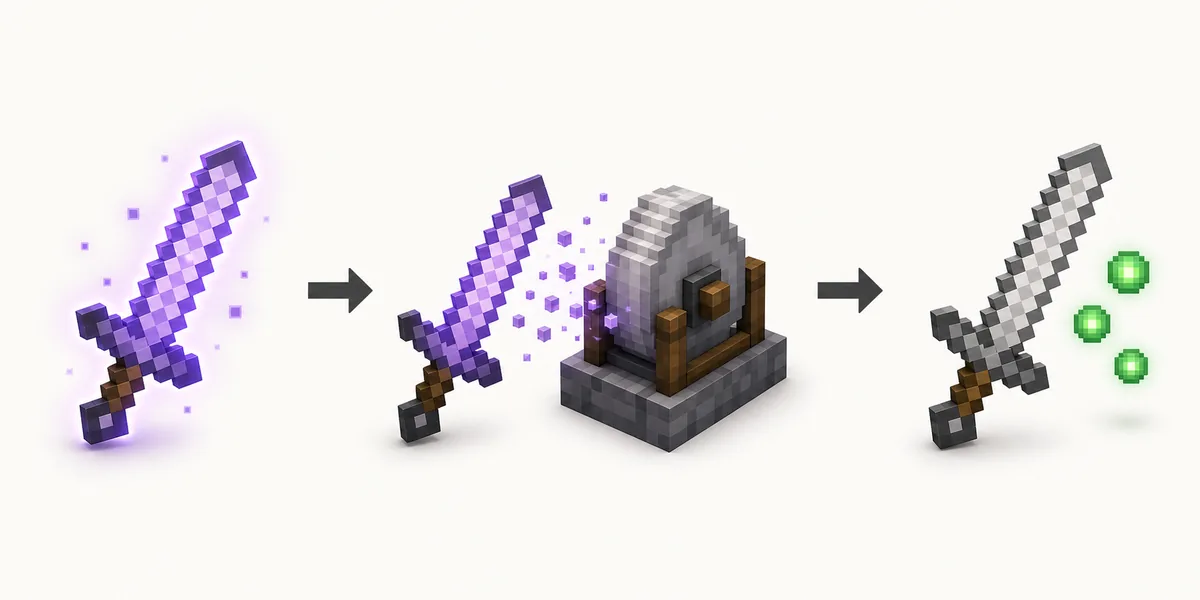
Safe habit: if the item contains a rare villager-traded book, a perfect tool, or a named piece of gear, make a copy or take a screenshot of its enchantment list before using the grindstone. The operation is intentionally destructive to normal enchantments.
What a Grindstone Removes
A grindstone removes normal enchantments that can be removed by vanilla disenchanting. That includes common item enchantments such as Sharpness, Efficiency, Mending, Unbreaking, Protection, Fortune, Silk Touch, and similar non-curse effects. The important rule is not the name of the enchantment; it is whether the enchantment is a curse.
Removal is all-or-nothing for the removable group. If a sword has Sharpness, Looting, Unbreaking, and Mending, the grindstone does not offer four separate controls. It produces a sword without that normal enchantment set. This makes the block excellent for cleaning a cheap experiment, but risky for a finished netherite item.
| Input situation | What happens | Best decision |
|---|---|---|
| Cheap item with unwanted normal enchantments | Normal enchantments are removed together. | Use the grindstone if you are happy to lose the entire set. |
| Finished item with one unwanted enchantment | There is no single-enchantment delete button. | Do not grind it unless losing every normal enchantment is acceptable. |
| Item with Curse of Binding or Curse of Vanishing | The curse remains. | Treat the item as cursed; a grindstone is not a cure. |
| Item with a large prior-work penalty | The cleaned output can be easier to rebuild. | Compare rebuilding from a fresh item with the cost of losing the old books. |
Can You Remove Just One Enchantment?
No. Vanilla Minecraft does not support selective disenchanting. If the problem is Knockback but the sword also has Sharpness, Looting, Mending, and Unbreaking, the grindstone cannot preserve the four useful enchantments while removing only Knockback. It treats the removable enchantment list as one group.
The practical choices are to keep the original item, build a new item with the enchantments you actually want, or use a server plugin, datapack, or mod that explicitly adds selective removal. A command or modded solution is not the same as a survival recipe, so check the rules of the world before you promise that it will work on Java or Bedrock.
Do not confuse a grindstone with an anvil. An anvil combines items and books; it does not remove a single enchantment. If you want to keep your existing enchantments, use the Minecraft enchantment calculator to plan a new anvil sequence instead of grinding the item first.
Curse of Binding and Curse of Vanishing
Curse enchantments are the most important exception. A normal grindstone cannot remove a curse, so do not put a cursed item into it expecting a clean result. The two curses most players encounter are Curse of Binding and Curse of Vanishing, and they create different problems.
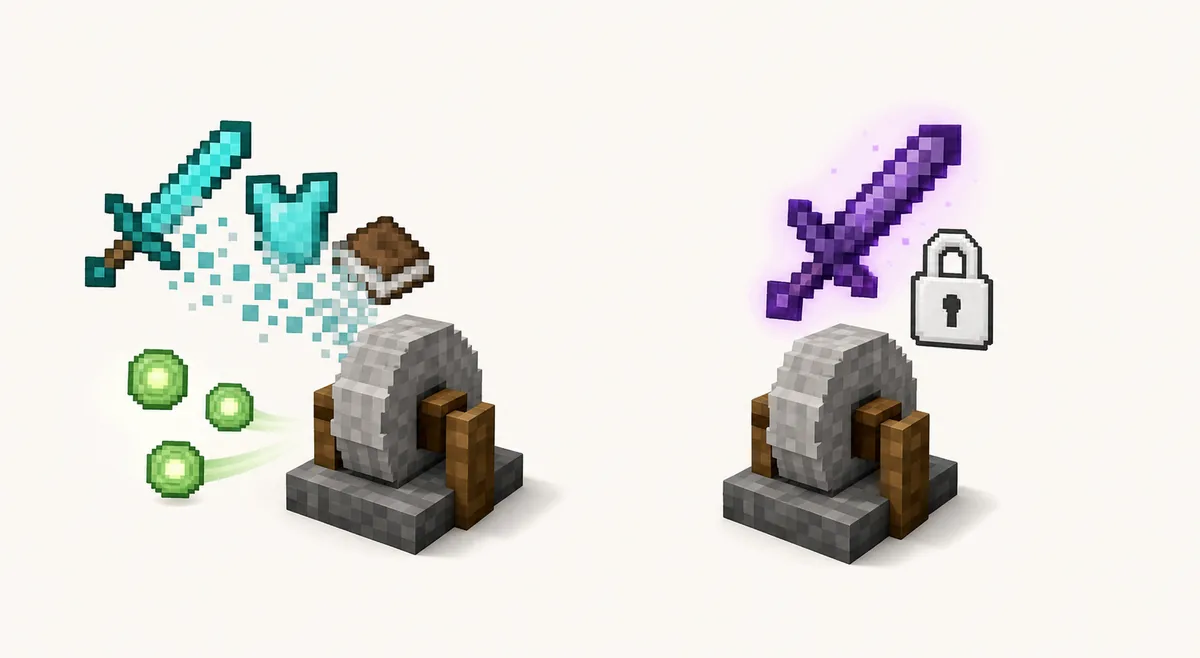
Curse of Binding
Curse of Binding prevents normal removal of an equipped piece of armor or wearable gear. A grindstone does not break that rule. If the cursed item is already worn, the safest survival advice is to avoid equipping it unless you accept the restriction; breaking or losing the item is a very different outcome from safely disenchanting it.
Curse of Vanishing
Curse of Vanishing is not a durability or repair upgrade. It changes what happens when the holder dies: the item can disappear instead of being recovered. A grindstone cannot turn it into an ordinary item, so a valuable weapon or tool with this curse should be treated as a risk rather than something you can clean later.
If you are comparing a cursed book with a normal book, read the full item tooltip before applying it. The Minecraft enchantment guide lists compatibility and curse behavior, while this page focuses on what happens after a cursed item is already in your inventory.
XP, Books, Names, and Prior Work
Does a grindstone give XP back?
It can return some experience when it removes normal enchantments, but it does not refund the original enchanting-table rolls, villager trades, or every anvil level you spent. Think of the XP as a small recovery value attached to disenchanting, not as an undo button for the entire crafting history.
Can you remove an enchantment from a book?
A grindstone can be used to strip an enchanted book, but it does not transfer that enchantment into a second book or store it for later. If your goal is to move an enchantment from one item to another, vanilla survival has no grindstone workflow that preserves the original enchantment. Save the book or trade for a new one instead.
Does disenchanting reset anvil cost?
A grindstone can remove the prior-work history that makes a repeatedly used item expensive at the anvil. That can make the cleaned item easier to rebuild, but the reset comes with a complete loss of the item's removable enchantments. If the current item already has the exact books you need, calculate the cheapest order before sacrificing it.
For the underlying penalty sequence and the reason a final operation can become “Too Expensive!”, read the Minecraft prior work penalty guide and the Minecraft anvil cost formula guide. Those pages are for keeping enchantments while changing the order; this page is for intentionally removing them.
Java, Bedrock, Commands, and Mods
The broad survival answer is the same for modern vanilla Java and Bedrock: use a grindstone for normal disenchanting, expect all removable enchantments to disappear together, and do not expect curses to be removed. Server settings, plugins, datapacks, and modpacks can add different recipes or command behavior, so a custom world may not match the vanilla result.
Commands can replace or edit an item in some editions and server environments, but command syntax and item-data rules change by version. Treat command removal as a technical, world-specific solution rather than a universal answer to “how to remove enchantments in Minecraft.” For ordinary survival play, a fresh item or a grindstone is easier to verify.
Want to keep the enchantments and only avoid a high anvil cost? Plan the book order before rebuilding the item.
Calculate an Optimal Enchantment OrderFAQ
How do you remove enchantments in Minecraft?
Craft or find a grindstone, open it, place the enchanted item in an input slot, and take the output. The grindstone removes all removable, non-curse enchantments at once and may return some XP.
How do you remove a specific enchantment in Minecraft?
You cannot remove only one enchantment in vanilla survival. A grindstone removes the whole removable group. Keep the original item, build a clean replacement, or use a clearly supported mod or server tool if selective editing is required.
Does a grindstone remove Mending?
Yes. Mending is a normal enchantment, so it is removed along with the other removable enchantments. Do not use the grindstone on a valuable Mending tool unless you intend to rebuild it.
Can a grindstone remove Curse of Binding?
No. Curse of Binding is a curse and a normal grindstone cannot remove it. Avoid equipping cursed armor unless you understand the survival consequences.
Can you remove Curse of Vanishing?
No. A grindstone does not remove Curse of Vanishing. The curse affects what happens to the item on death, so it should be treated as a deliberate risk rather than an enchantment that can be cleaned later.
Does the grindstone give back all the XP used for the enchantment?
No. It may return some experience from removing normal enchantments, but the amount is not a full refund of enchanting, trading, or anvil costs.
Is a grindstone better than an anvil for removing enchantments?
The grindstone is the normal vanilla tool for removal. An anvil is for applying or combining books and items, so use the anvil when you want to preserve enchantments and use the grindstone only when losing the removable set is acceptable.
Sources and Further Reading
- Grindstone - Minecraft Wiki for the block's recipe, disenchanting behavior, and output rules.
- Curse of Binding - Minecraft Wiki for the wearable-item restriction.
- Curse of Vanishing - Minecraft Wiki for the death-related item risk.
- Minecraft Enchantment Guide for compatibility, max levels, and the wider enchantment list.
- Prior Work Penalty in Minecraft for the anvil history that can make rebuilds expensive.