ATM10 Apotheosis Anvil Prior Work Penalty: Levels vs XP Cost Explained
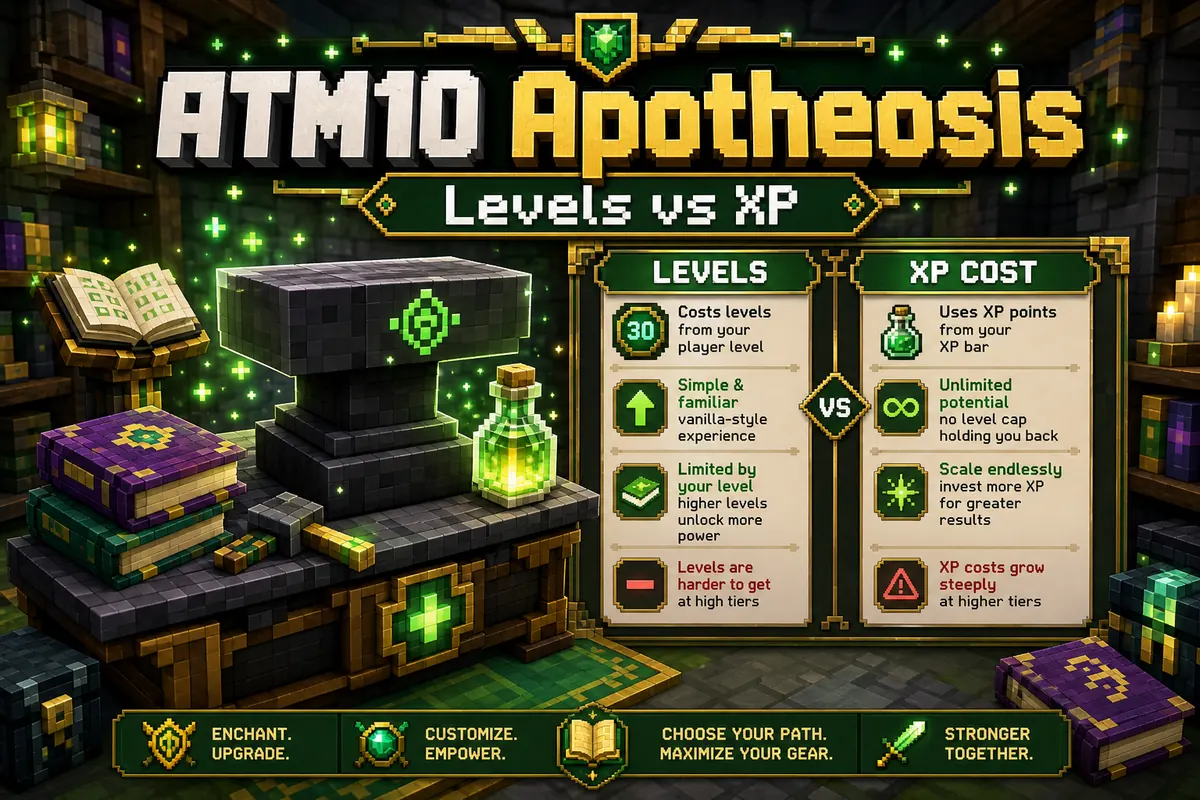
If you searched for ATM10 Apotheosis anvil prior work penalty, you are probably staring at an anvil cost that feels wrong: a paxel, sword, pickaxe, or enchanted book suddenly asks for a huge amount of XP, or the number does not match a vanilla Minecraft anvil guide. The short answer is this: prior work penalty still matters, but ATM10 and Apotheosis-style enchanting can change how the cost is displayed, paid, capped, or scaled.
This page is intentionally narrow. It is not another generic Minecraft anvil cost guide, and it is not trying to replace the in-game behavior of a modpack. Instead, it explains why levels vs XP cost causes confusion in ATM10, how vanilla prior work penalty gives you the baseline, and how to troubleshoot expensive modded items without wasting rare enchantments.
Table of Contents
1. Quick Answer: What Is Happening?
In vanilla Minecraft, each anvil operation can add a hidden prior work value to the item that survives the operation. That hidden value becomes extra cost later. In a modpack such as All the Mods 10, the same concept can be layered with Apotheosis or Apothic Enchanting changes, extra enchantments, altered caps, and modded item types.
The most common misunderstanding is treating "30 levels" as if it were a fixed amount of experience. Minecraft levels are not linear. Going from level 1 to level 2 is cheap; going from level 80 to level 81 costs far more raw XP. If a modded enchanting system charges or displays cost closer to actual XP instead of the vanilla level subtraction model, the number can look surprising even when the underlying operation is reasonable.
Practical rule: Use vanilla prior work penalty to understand why repeated anvil use gets expensive, but verify final ATM10 costs in the pack because Apotheosis configuration and pack updates can change the exact result.
2. What Players Are Actually Asking
The queries around this topic are not broad beginner queries. They are troubleshooting searches from players who already know the anvil is doing something hidden. The pattern usually looks like this:
| Search phrase | Likely problem | Best answer type |
|---|---|---|
| ATM10 Apotheosis anvil prior work penalty levels | The player sees a high level or XP requirement and wants the penalty table. | Baseline formula plus modpack caveat. |
| ATM10 Apotheosis anvil prior work penalty levels vs XP | The player is confused by the difference between level count and raw experience cost. | Explain non-linear XP levels. |
| Apotheosis mod prior work penalty anvil cost | The player wants to know whether Apotheosis changes vanilla anvil behavior. | Separate vanilla mechanics from modded configuration. |
| ATM10 Apotheosis anvil prior work penalty levels cost paxel | A multi-use tool became expensive after several enchants, repairs, or book combinations. | Item-specific troubleshooting steps. |
3. Vanilla Prior Work Penalty Baseline
Vanilla prior work penalty is the clean baseline because it explains the shape of the problem. Every time an item is worked in an anvil, the item that remains can become more expensive to use later. In Java Edition documentation, the penalty cost follows a doubling-style pattern.
| Previous anvil work count | Added prior work penalty cost | What it means in practice |
|---|---|---|
| 0 | 0 | Fresh item or book. This is ideal for expensive enchantments. |
| 1 | 1 | Still manageable. One previous operation rarely ruins the item. |
| 2 | 3 | The penalty is visible but usually still workable. |
| 3 | 7 | Planning starts to matter. Repeated direct applications become risky. |
| 4 | 15 | One expensive enchantment can push the operation near the vanilla cap. |
| 5 | 31 | Almost no room remains for costly enchantments in vanilla rules. |
The important lesson is not the exact table alone. The lesson is that a "small" extra anvil use early can become a major cost later. That is why combining books in a balanced order is usually better than adding every book directly to the same tool one by one.
4. Levels vs XP Cost in ATM10 Apotheosis
Vanilla anvil costs are normally shown as levels. Players often talk about the 39-level limit because that is the classic vanilla survival cap for expensive operations. Modded enchanting systems can change this experience. Apotheosis-family enchanting has historically focused on deeper enchantment mechanics, and modern pack setups may include Apothic Enchanting or related modules/configuration rather than a single simple vanilla rule.
The key distinction is that levels are a display unit, while XP is the underlying resource. A level number is not linear. Losing 5 levels at level 20 is not the same raw XP loss as losing 5 levels at level 90. Use the Minecraft XP calculator if you want to compare raw XP points with vanilla player levels before troubleshooting a modded cost. That is why a system that charges real XP can feel fairer mathematically but harsher visually when you are carrying many levels.
| Cost model | How players experience it | Why it matters |
|---|---|---|
| Vanilla-style level cost | The anvil asks for a number of levels and subtracts that many levels. | Simple to understand, but one high level can represent much more XP than one low level. |
| Real XP-style cost | The operation may be based on raw experience points behind the scenes. | More consistent as a resource cost, but less intuitive if you expect vanilla level behavior. |
| Pack-configured modded cost | ATM10 may combine mod defaults with pack balance changes. | The exact result can differ from vanilla guides, older Apotheosis posts, or another modpack. |
Do not assume every old Apotheosis answer applies to ATM10. Mod names, module splits, and pack configuration can change over time. Use old forum or Reddit answers as clues, then verify against your installed pack version.
5. Why Paxels and Modded Tools Get Expensive
Paxels and other modded multi-tools are a common source of confusion because they often invite many enchantments. A pickaxe only needs a mining-focused set. A paxel may feel like it should carry tool enchantments across pickaxe, axe, and shovel roles, sometimes with extra modded enchantments on top.
More enchantments mean more chances to make one of these mistakes:
- Adding books one at a time: This raises the main item's prior work penalty repeatedly.
- Using pre-combined books: The book may already carry prior work penalty before it reaches the final item.
- Repairing before finishing: Anvil repairs can add work history, making later enchantments more expensive.
- Mixing vanilla and modded enchantments: Extra enchantments may have different weights, caps, or compatibility rules.
- Renaming during trial attempts: Rename cost is small, but repeated anvil experiments still create confusion when diagnosing the final cost.
For an ATM10 paxel, the safest strategy is to plan the full build before touching the anvil. Decide whether you need Fortune or Silk Touch, whether Mending is available, and which modded enchantments are truly worth the cost. Then combine books in pairs before applying the final grouped book to the item.
6. Paxel Cost Diagnosis Example
Here is a practical way to diagnose the long-tail problem behind searches like ATM10 Apotheosis anvil prior work penalty levels cost paxel. Suppose you have a paxel with Efficiency, Unbreaking, Mending, Fortune, and one or two modded enchantments. The anvil suddenly asks for a much higher cost than expected.
Do not start by replacing the whole build. First, separate the possible causes. A high cost can come from the paxel's own work history, a book that was already combined several times, an expensive modded enchantment, or a pack-level cost rule. These causes look similar in the anvil UI, but the fix is different.
| Test | What to compare | Likely conclusion |
|---|---|---|
| Fresh paxel + same final book | Compare against your original paxel. | If the fresh paxel is much cheaper, the original paxel already has prior work penalty. |
| Original paxel + fresh single book | Use a clean vanilla enchantment book such as Unbreaking or Efficiency. | If even a simple book is expensive, the item history is probably the issue. |
| Fresh paxel + modded enchantment book | Compare with a vanilla book at a similar level. | If only the modded enchantment is expensive, check enchantment weight, rarity, or pack configuration. |
| Grouped books vs one-by-one books | Compare a balanced book tree with direct book application. | If grouping is cheaper, the problem is mostly anvil order rather than the enchantment itself. |
This example also explains why advice from a vanilla anvil guide can be correct but incomplete for ATM10. The prior work penalty pattern still teaches you what to avoid, while the exact ATM10 Apotheosis cost must be confirmed in the installed pack.
7. Troubleshooting Checklist
If your ATM10 Apotheosis anvil cost seems too high, work through the issue in this order. This avoids guessing and helps you identify whether the problem is prior work penalty, XP display, item history, or pack configuration.
Test with a fresh copy of the item and fresh books.
If the cost drops sharply, the original item or book already has prior work history.
Compare one enchantment at a time.
Apply only the most expensive enchantment in a test world or backup. If that alone is high, the enchantment weight or modded config is likely involved.
Check whether the number is levels or raw XP behavior.
Watch the actual XP bar change. A display that feels strange may still be charging raw experience consistently.
Stop using the main item for experiments.
Repeated trial operations are exactly how expensive prior work histories are created. Use copies, backups, or a creative test world.
Look for pack-specific configuration.
ATM10 can ship balance choices that differ from another Apotheosis setup. When exact numbers matter, the installed modpack version is the source of truth.
8. When to Use the Minecraft Enchantment Calculator
Our Minecraft enchantment calculator is best used as a planning tool for vanilla-style combining order. It is especially useful for understanding why balanced book grouping beats repeated direct applications. That principle remains valuable in ATM10 even if the final cost differs.
However, do not treat a vanilla calculator as an exact price quote for a heavily modded setup. Use it to choose the order, then confirm the final operation in ATM10 before spending rare materials or one-of-a-kind books. If the pack has changed enchantment weights, max levels, anvil caps, or XP charging, the real in-game result wins.
| Use the calculator for | Verify in ATM10 for |
|---|---|
| Balanced book combining order | Exact XP or level cost shown by the modded anvil |
| Avoiding repeated prior work on the main item | Modded enchantment compatibility and max levels |
| Planning vanilla enchantments such as Mending, Unbreaking, Efficiency, Fortune, and Silk Touch | Apotheosis/Apothic-specific enchantments and pack balance changes |
9. FAQ
What is ATM10 Apotheosis anvil prior work penalty?
It is the accumulated anvil-use cost attached to an item or book, interpreted inside an ATM10 modded environment. The vanilla prior work penalty explains why the cost grows after repeated anvil operations, while Apotheosis-family changes and ATM10 configuration can affect the final displayed or paid cost.
Why are ATM10 Apotheosis anvil levels different from XP cost?
Minecraft levels are not a linear currency. Higher levels contain more raw XP than lower levels. If a modded system uses or exposes raw XP behavior, the cost can feel different from a vanilla guide that only talks about subtracting level numbers.
Does prior work penalty reset in ATM10?
Do not assume it resets unless your specific pack setup adds a clear way to do so. In vanilla Minecraft, prior work history is intentionally persistent on the item that survives the anvil operation. Some modded mechanics may add workarounds, but those are pack-specific rather than a universal Apotheosis rule.
Why is my ATM10 paxel so expensive to enchant?
A paxel often receives many enchantments and may have already been repaired, renamed, or combined with pre-worked books. That combination creates high prior work history quickly. Start with fresh books, group books in pairs, and apply the final grouped enchantments to the paxel as late as possible.
Can I use vanilla Minecraft anvil mechanics for Apotheosis?
Use vanilla mechanics as the baseline for reasoning about order and prior work penalty. For exact ATM10 Apotheosis cost, check in-game because modded enchantments, pack config, and XP charging can change the final number.
What is the best way to avoid too expensive anvil costs in ATM10?
Plan the final build first, avoid anvil repairs before enchanting, use fresh books when possible, combine books in balanced pairs, and test the sequence on copies before committing rare tools or books. For vanilla-compatible enchantments, use the enchantment order calculator to reduce unnecessary prior work.
Sources & Further Reading
- Anvil mechanics — Minecraft Wiki, used for vanilla prior work penalty behavior and baseline anvil mechanics.
- Apotheosis — CurseForge, used as a reference point for the mod family and its enchantment-focused scope.
- How to Calculate Minecraft Anvil Costs, our detailed vanilla cost formula guide.
- How Minecraft Anvil Works, our explanation of work penalty, combining order, and "Too Expensive" cases.
- Minecraft XP Calculator, for converting raw XP points, player levels, and level ranges.